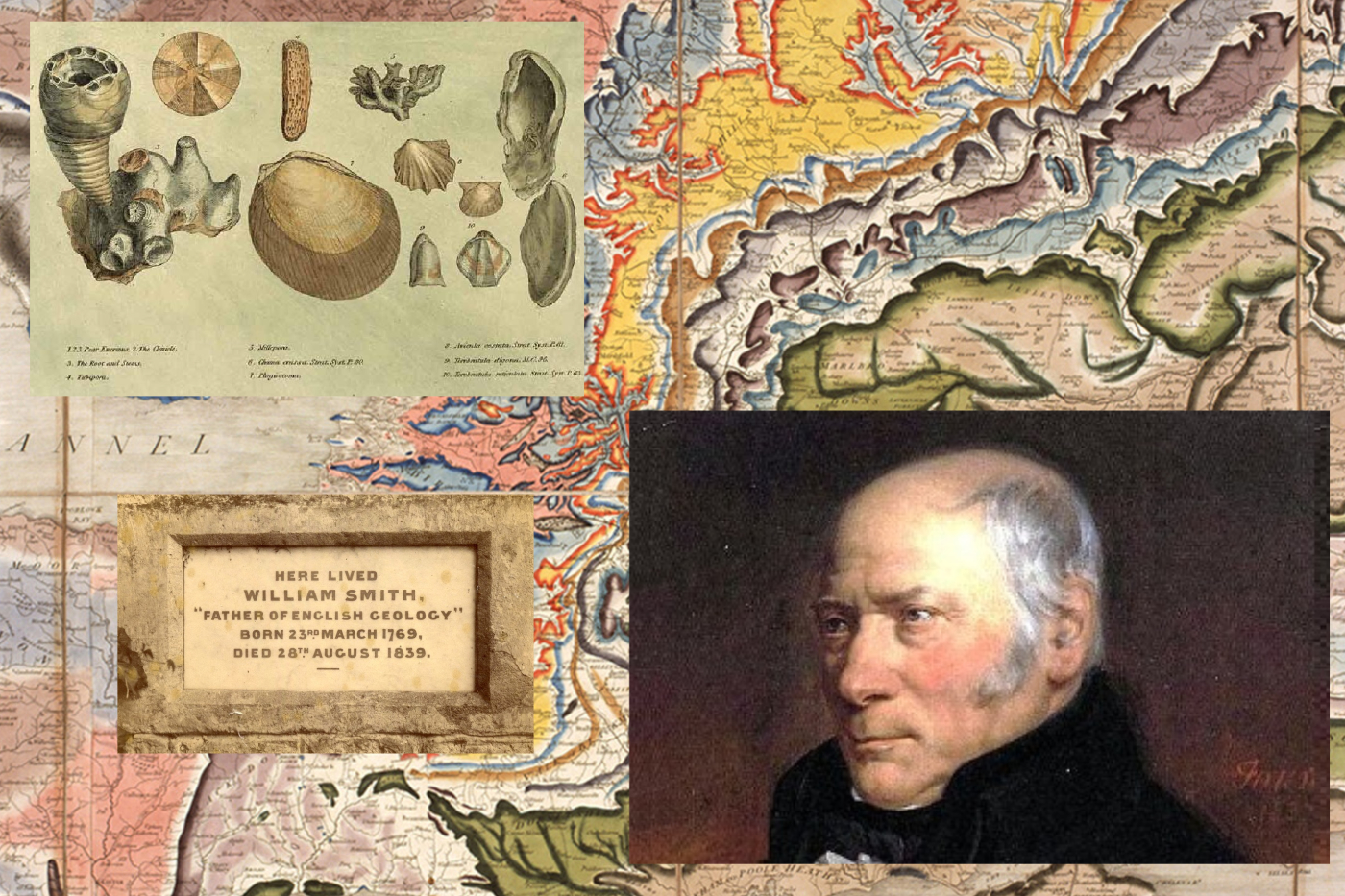
The story of William smith
The story of how a canal engineer’s observations of rock layers led to the discovery of stratigraphic succession and revolutionised our understanding of Earth’s history.
Talk: Yes | Workshop: Yes | Course: No | Audience: Public, Families
William Smith (1769–1839), often called the “Father of English Geology,” transformed how we understand Earth’s deep past by realizing that rock layers follow a consistent order—and that fossils within them can be used to identify and correlate those layers across long distances. Crucially, this breakthrough wasn’t born in a university or laboratory, but in the muddy cuttings of Britain’s canal-building boom. Working as a surveyor and engineer on canal projects, Smith had an unmatched opportunity to observe freshly exposed cliffs and excavations, watching distinct bands of clay, limestone, and sandstone appear again and again in a reliable sequence as the canals sliced through the countryside. These practical, repeated observations convinced him that strata were not random, but patterned and mappable—an insight that led to his pioneering geological maps and the enduring theory of stratigraphic succession that still underpins modern geology.